This book is all about building Habit-forming products that we can easily find around us. These products evolve over the years to ease the consumer’s experience and become addictive. Let’s dive into a real-life product case study with a hooked model, as explained in this book. Note: The below analysis is detailed with respect to my understanding and may need some update.
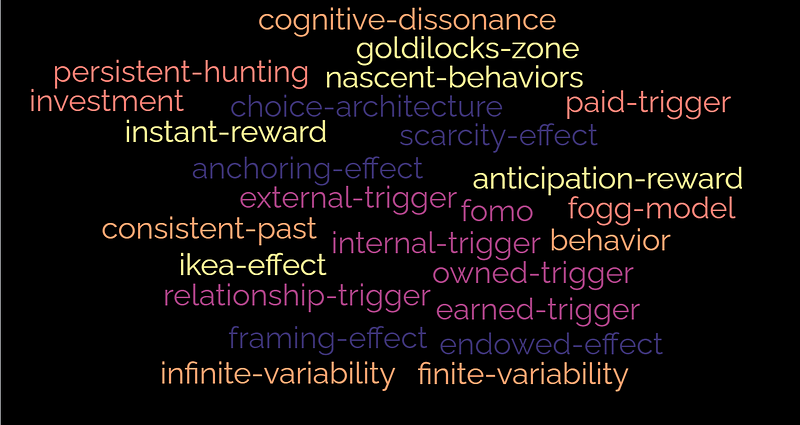
Do you know how notifications on our mobile devices impact us?
There are many activities around one product’s ecosystem, like different types of notification, types of sound, visual appearance, types of engagement, types of effects, app icons, etc. But why do they need to create all this?

Case Study: Duolingo
Recently, we have started learning a new language using a gamified approach. During the usage of this app, we observed below things around it.
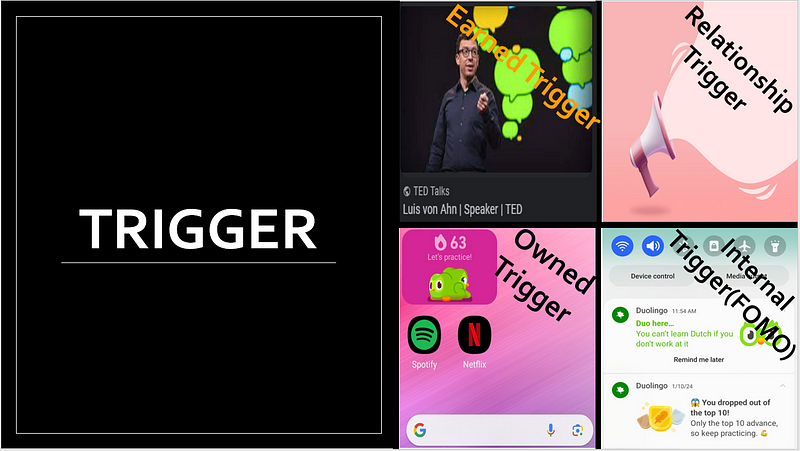
T1. We came to know about this app while watching a TED Talk.
T2. Some of our friends were using this app.
T3. After Installation (Usage), the app icon in mobile phone.
T4. Fear of missing out emotion trigger to learn again.
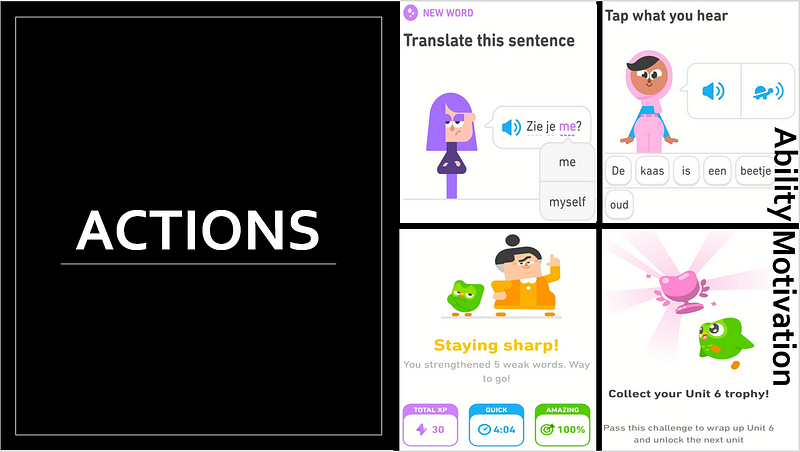
A1. After installation, it is easy to use as it starts with basic words. It has a feature to tap on a new word and know the meaning.
A2. We can repeat listening task with slow pace as it is required in the beginning. This represents ability in Fogg’s behavior model.
A3. After completion of each lesson, we get instant reward like “Perfect Lesson”, “Staying sharp”, “Collect Trophy” etc. This represents motivation in Fogg’s behavior model.
V1. By clearing more lessons, we move to the next units and sections of learning and moving up in the rank of league.
V2. Visual reward with sound enhance the user experience.
V3. We can share the progress in Social Media.
V4: Infinite Variability: We just started learning a language, but there are more sections yet to unlock

I1. Notification for not losing streak, which represents Consistent with past behavior.
I2. Power (hearts) is restored every next day to start again. Rewards double with more progress, which reflects Anticipation of reward.
I3. We can earn power (like hearts) if we practice more, aka IKEA effect.
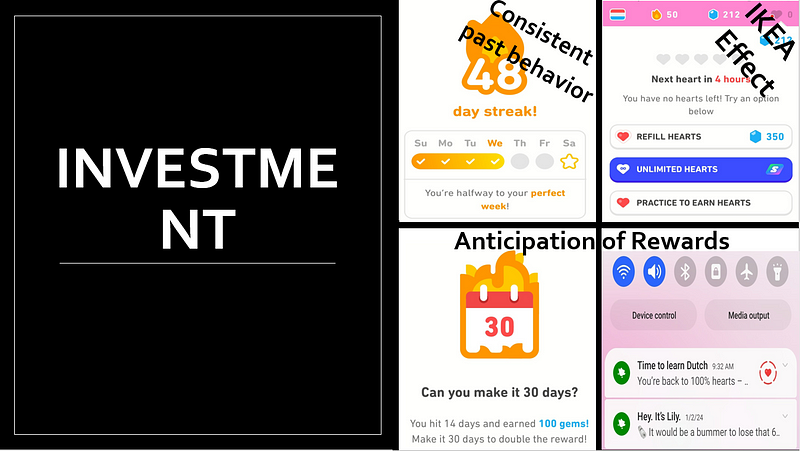
This book illustrates four different stages of the product life cycle by which the user engages, takes action in anticipation of rewards and comes back to use it again and again, which leads to addiction. These well-knowned products were hardly solving any critical problems (aka painkillers) when started, but with time, they have changed and become part of the daily routine. This is an attempt to show some use cases of the product Duolingo using the hooked model.
Do you know, how small mice defeated mighty tanks in WWII?
Then click on this link, 10 real-life example from the psychology of money.

 InvestOnSelf
Leave a comment