This book outlines steps to create habits and then keep those good habits for a thriving future. The author mentioned his own personal life story with other fascinating real-life examples to explain these steps and their benefits. Motivation and inspiration are overrated, while habit is underrated.
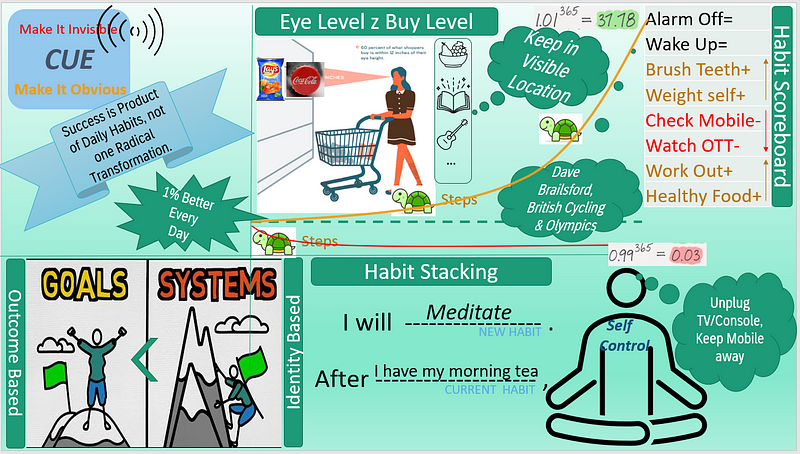
- Keep a habit scoreboard with good, bad, and neutral habits to track behaviour and try to increase the count of good habits in that scoreboard.
- Consumers choose the products because of how the products are presented to them and where they are available—at eye level. Similarly, if we want to read a book, eat fruit, or play guitar, keep it in a visible location. Otherwise, things are ignored if they are hidden and not easily accessible.
- Dave Brailsford made small improvements for the British cycling team, which led to record-breaking achievements in many events for a couple of years, including the Olympics.
- To create a new habit, stack up the new habit after the current habit, and it will be easy to follow the new one.
- Bad habits are autocatalytic. So use self-control to avoid them, like Unplug gaming console and TV, Keep mobile away, etc.
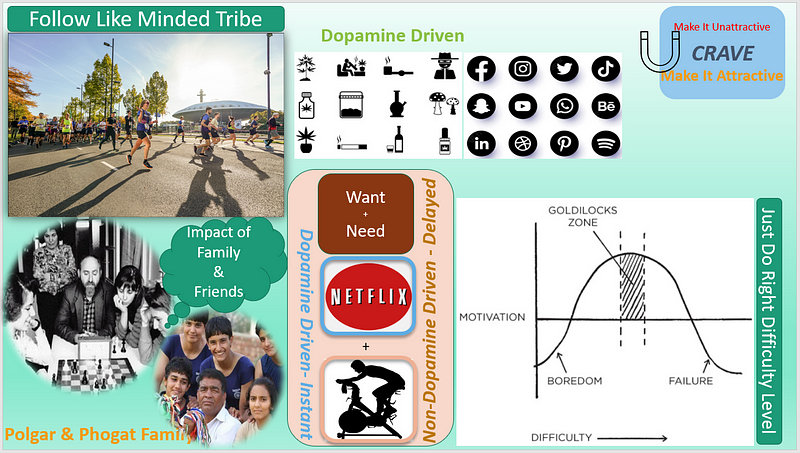
- We consume many things in our daily routine which are mostly dopamine driven, and these give instant gratification in return to repeat.
- Use temptation building; pair a habit which we want to do with a habit which we need to do. One habit gives instant gratification (want to do), while the other gives delayed gratification (need to do).
- The role of family and friends helps us to adopt and imitate habits easily. The best examples are the Polgar family (for chess) and the Phogat family (for wrestling).
- Follow like-minded people to get motivation (mainly during the initial stage) of any habit.
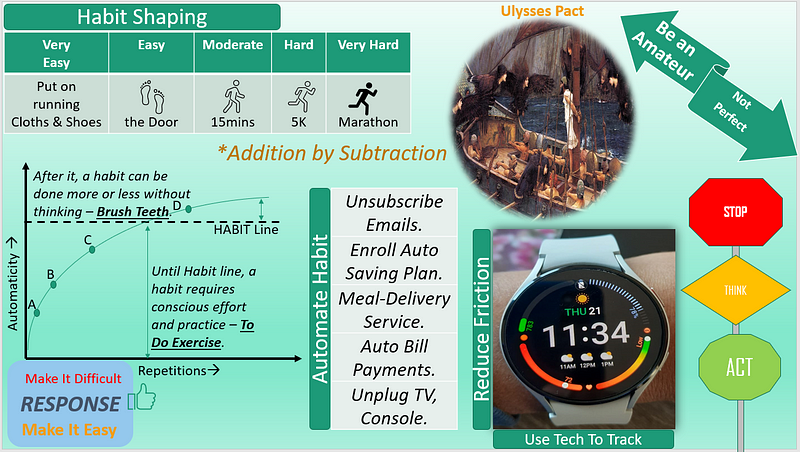
- Reduce the friction to make good habits easy and vice versa. Choose a gym close to home/office, use Tech to track activities, etc.
- Don’t try to be perfect instead be amateur, which gives you more scope to try new ideas and new activities with different approaches.
- Use the 2-minute rule to start with small steps and then progress to the next level one by one, Habit Shaping.
- During the initial phase of a new habit, we need more conscious effort and practice. With regular progress, new habits look easy. After a certain level with a number of practices (Habit Line), the same habits can be done without conscious thinking.

- What is rewarded is repeated, and what is punished is avoided.
- Visual rewards are more satisfying. Use the paperclip strategy to count small progress after the completion of the task.
- Track your habits in Calendar. In the beginning it looks silly, but when you look back after one month/year, we can feel visual satisfaction with progress.
- Use a habit contract to check the commitment to the main objective with accountability partners.
- Don’t break the chain of good habits more than twice.
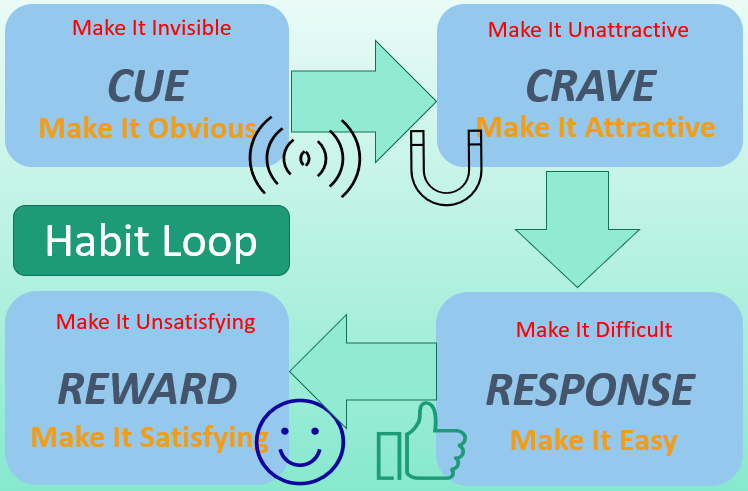
Four laws of behaviour change, mentioned in the book, form a habit loop.
Better to follow identity-based habits (focus on system/process) rather than outcome-based habits (focus on goal/product).
Just do it on the right difficulty level, as Goldilocks rules say. Neither very difficult nor very easy.
This is an attempt to brief some important points here. We should not stop here; instead, read the complete book to get the most benefit out of it.
Do you like to know how small steps create a big impact over time? Then check the Japanese strategy Kaizen principle and its impact.

 InvestOnSelf
Leave a comment